Rosehip House Recognised at ATLAS25 for Delivering Secure Supported Living
Rosehip House in Islington, North London was commended in the Heathcare category award at ATLAS25, the Secured by Design Awards that recognises excellence in designing out crime.
Providing supported living for 11 adults with learning disabilities Rosehip House comprises of seven modern 1-bedroom flats and a four-home pod where residents who need greater support live together with a shared kitchen and dining space. Located in the heart of the community, the development offers not only safe and secure housing, but also the opportunity for residents to live independent and fulfilling lives in their local area. The scheme was designed in partnership with Islington’s Adult Social Care team and the Learning Disability Partnership.
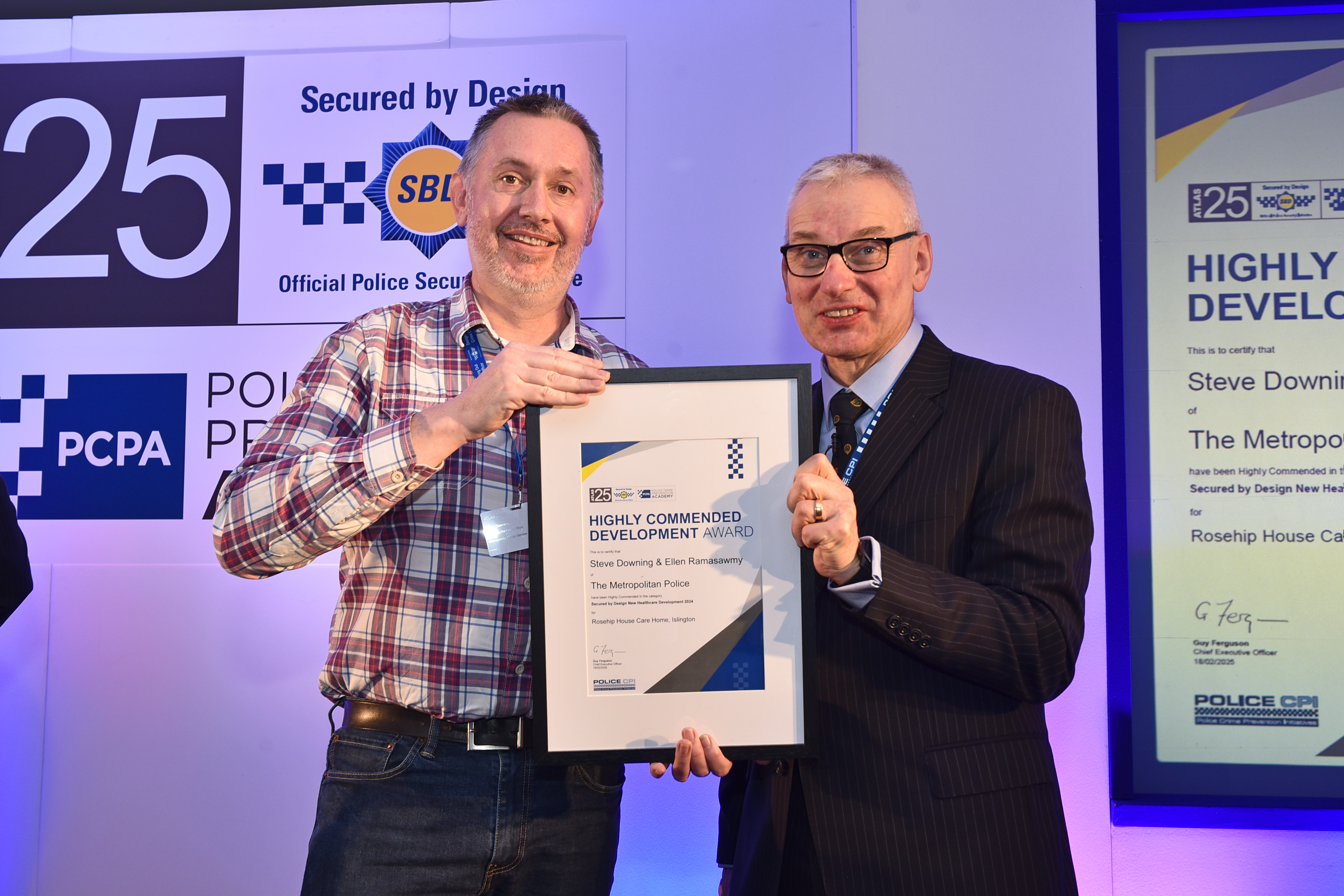
From its inception DOCOs (Designing out Crime Officers) from the Metropolitan Police, Steve Downing and Ellen Ramasawmy, played a key role in the development and its success.
The first challenge was the location itself – a former dilapidated car park with disused garages which was heavily linked to crime and anti-social behaviour. The DOCOs had to ensure they created a safe, secure environment for vulnerable adults with complex needs without them become targets in an area known for criminal activity.
The team also faced the task of creating a set of welcoming homes that promoted a sense of wellbeing and calm while balancing operational requirements and incorporating stringent safeguarding measurements for the residents. It was also critical that the facility was easy for residents with learning disabilities to navigate and wasn’t too overbearing.
Working closely with the local planning officer and the design team and building contractor, Rooff, DOCOs Steve and Ellen proposed some significant changes to the original design to help meet this challenge.
The Designing out Crime Officers implemented secure ‘onion layering’ throughout the scheme - a security approach where multiple layers of protection are used like the layers of an onion. If one layer is breached there is another secure layer inside. The result is a system of multiple secure primary and secondary doors before the building can be entered, followed by a secure outer boundary and further controlled access to the rear and side entrances.
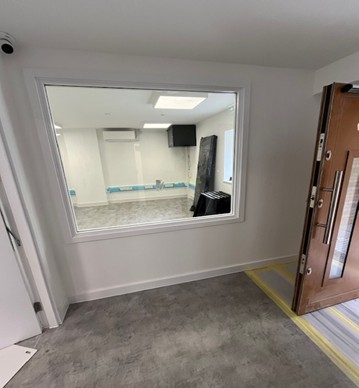
Secure external door with vision panel, multiple locking and large handle for ease of use for residents with reduced mobility. Vision window for staff with laminated glass to allow screening of those entering whilst remaining safe behind secure secondary door.
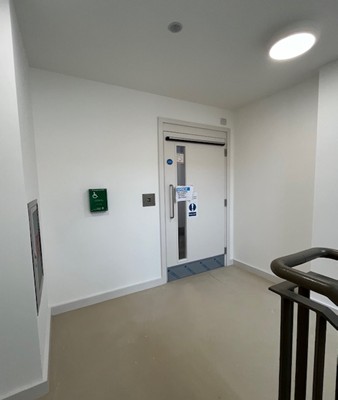
Secure access controlled internal doors upon each floor to provide additional layers within, so that staff have greater control upon resident movement and those considered more vulnerable.
Throughout the design the DOCOs also had to carefully balance accessibility with robust security, for example integrating power-assisted features such as automatic doors for disabled users whilst ensuring residents remained protected. One particular challenge was finding a suitable communal aluminium doorset that could only be opened inward due to the requirements of the disabled users without compromising on security. The solution was a PAS24 door-set incorporating power assisted opening, dual maglocks with a fob reader, CCTV coupled with 24/7 site presence.
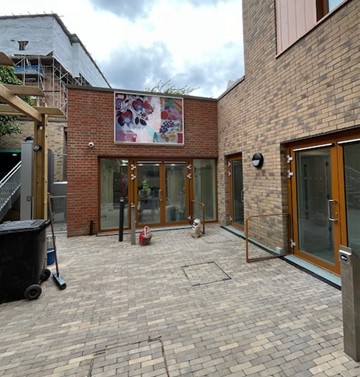
Outside communal space with secure doors and bulkhead lighting present along with access control and CCTV on wall.
Another problem area was the limited space on site which meant the building’s power generator had to be positioned in the rear garden facing a public area and the fire escape route had to go past the generator enclosure. This raised both safety and security concerns which were addressed with a series of measures including an increase of the boundary fence height and an anti-climb gate with multiple internal locking points. Crucially the design also included a fail-safe emergency release mechanism to ensure safe evacuation in the event of a fire.
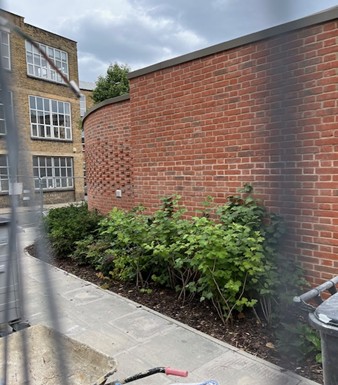
Defensive planting close to the power generator provides a protection barrier to deter intrusion, gives screening and helps deter criminal damage such as graffiti.
The result is a welcoming setting where residents can enjoy their own space along with a shared sunny rear garden, two communal lounges, assisted bathrooms, a wheelchair transfer room, laundry room, cycle storage and modern staff facilities including overnight accommodation for care workers.
The development has also had a positive impact on the wider area. To date crime stats show no reported incidents, demonstrating that careful urban planning can play a vital role in preventing crime.
DOCO Steve Downing said, “I was delighted to award Rooff with SBD accreditation for Rosehip House. The site is located within an area that experiences high levels of anti-social behaviour, theft and other offences so it was essential to design in crime prevention measures to help to protect against incidents such as these. Introducing these new residential premises onto this site has helped to activate the area from what was previously a set of isolated garage blocks with lower levels of legitimate daily activity and natural surveillance. The extent of the security and crime prevention measures applied by Rooff and with compliance to SBD measures not only provides it with the resilience to help to protect its residents and staff but was successfully designed and incorporated not to feel complicated, over-bearing or hostile in nature. Well done to all involved.”
Principal New Homes Development Manager, Souad Akbur at Islington Council, commented, “Rosehip House is home to 11 residents with learning disabilities. The building was designed to promote independence, sensitivity and comfort in a safe environment. With its numerous, but discreet security features residents are able to thrive, feel safe and happy in their new homes.”
-------------------------------------------------------------
What is Secured by Design?
Secured by Design (SBD) is the official police security initiative that works to improve the security of buildings and their immediate surroundings to provide safe places to live, work, shop and visit.
SBD’s product based accreditation scheme – the Police Preferred Specification - provides a recognised standard for all security products that can deter and reduce crime.
There are currently many hundreds of companies producing thousands of attack resistant crime prevention products, across 30 different crime categories, which have achieved Police Preferred Specification.
Improved security
Developers around the UK can achieve SBD awards for incorporating crime prevention measures and techniques into their developments in all kinds of building sectors, such as residential, education, health, transport, commercial, retail, sport and leisure. Indeed, SBD can be used as evidence to discharge third-party obligations under Part Q of Schedule 1 (Security) to the English Building Regulations, the Scottish Building Standard 4.13 (Security) and Welsh Building Regulations Part Q (Security – Dwellings). These awards are gained by working with police Designing Out Crime Officers (DOCOs), who advise architects, developers and local authority planners long before construction begins – and continue to provide advice and guidance until the development is complete.
Academic and other research shows that improving standards of security in brand new and refurbished properties, helps deter and reduce crime. Reducing crime and the fear of crime has direct links to better physical and mental well-being, such as with regard to high volume crimes like domestic abuse.
The built environment influences the behaviour of people who work, live, socialise or simply pass through. SBD seeks to create environments where the law-abiding feel safe and secure whilst at the same time causing the criminal or anti-social to feel vulnerable to detection and thereby influence behaviour in a positive way. This continues to be a key objective for SBD.
Find out more about SBD Developers Awards here.
SBD Design Guides
SBD has produced a series of authoritative Design Guides to assist the building, design and construction industry to incorporate security into developments to comply with the Building Regulations in England, Scotland and Wales and meet the requirements of SBD.
These Design Guides, available to download for free at the SBD website, have been updated over the years to keep pace with changing patterns of criminal behaviour and advances in building design and new technology.
They are a valuable source of reference to architects, developers, self-builders, local authority planners and police officers and cover a range of building sectors, including residential, education, health, transport and commercial.
Police Designing Out Crime Officers
DOCOs provide specialist crime reduction advice to the public, businesses and colleagues about premises or property security. They also work with building developers, architects, and council planning departments regarding new developments and refurbishments, to 'design out' crimes like burglary and anti-social behaviour (ASB) by providing advice on street lighting, building and street layout, entrances and exits - as well as preferred standards and specifications for doors, windows, and locks, under the Secured by Design initiative.
DOCOs are able to deliver site specific interventions required to help design out crime in areas that suffer disproportionately from acquisitive crime, based on local crime pattern analysis, police, local authority and community engagement and the collective knowledge and experience of how criminals behave.
DOCOs are specialist problem solvers, working every day to make a positive difference, changing lives for the better and helping people to be safe and secure in their homes.
Contact details for local DOCOs can be found here.