ATLAS DOCOs of the Year: Making homes safer for domestic abuse victims
"Since April 2025, these two Designing Out Crime Officers have provided specialist safeguarding support to 226 high-risk victims of domestic abuse...applying SBD Sanctuary principles with care and precision, ensuring that tailored safety measures are recommended and implemented through determined partnership working." ATLAS nomination.
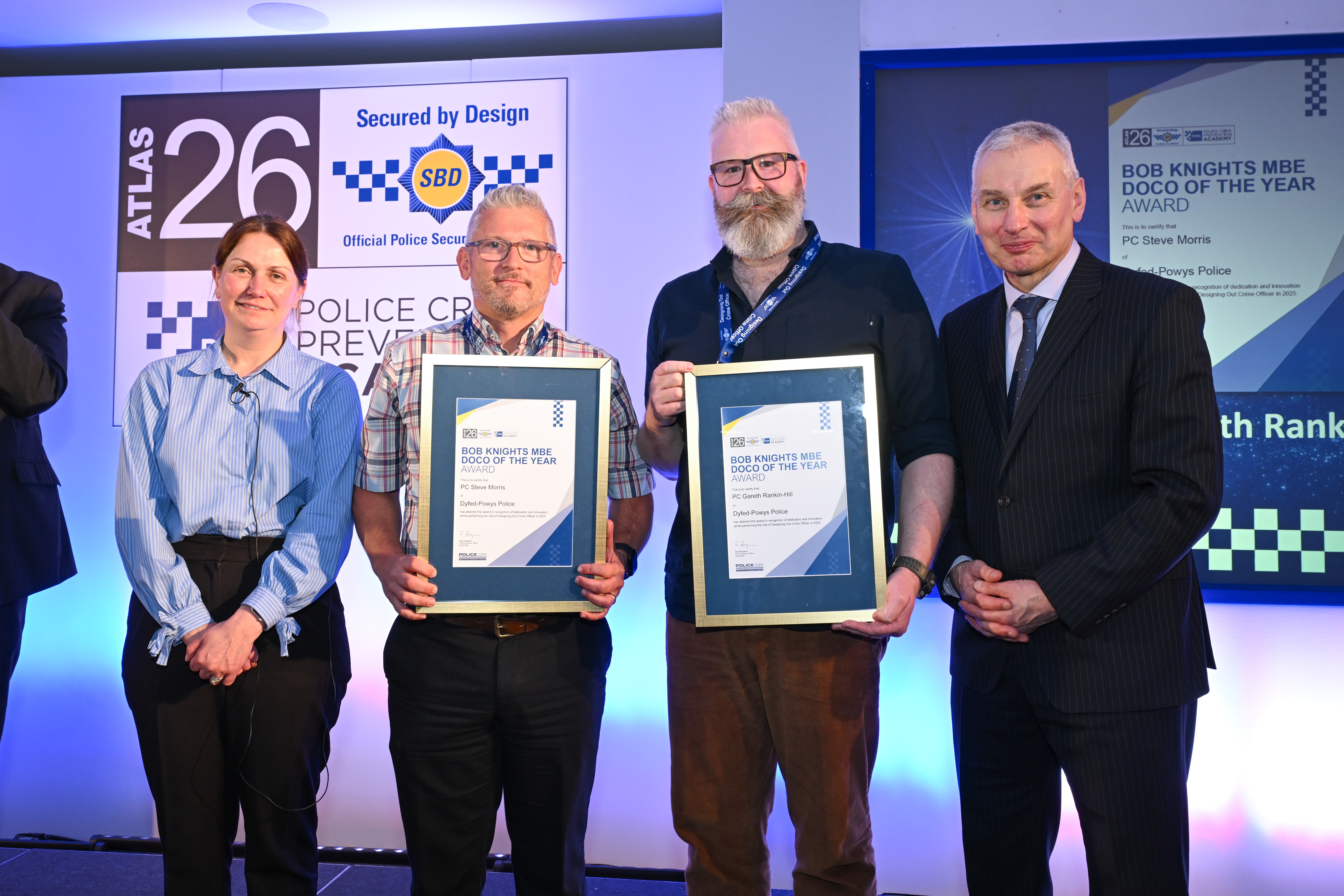
PC Steve Morris and PC Gareth Rankin-Hill from Dyfed‑Powys Police are this year’s joint ATLAS DOCO (Designing out Crime Officer) of the year, recognised for their dedication to crime prevention and work supporting victims of domestic violence abuse. Police CPI wanted to find out more….
Congratulations both of you, what do you think about your nomination and winning?
Steve: We actually took our Sergeant with us to ATLAS this year to learn more about our role, so it was a shock when it was announced Gareth and I had won DOCO of the year. The hairs stood up on the back of my arms, it’s amazing to be recognised by your peers who understand crime prevention and safeguarding, it means so much more.
Gareth: No one in our force really understands our job, so to receive this award is really significant for us. There are only two of us who have to manage a huge geographical area. Sometimes we call each other ‘How many have we got on the list today?’
Tell me about the ongoing work you’ve been doing that resulted in this nomination?
Gareth: Along with our day job of working on developments in the built environment, we have also been delivering safeguarding advice and applying SBD (Secured by Design) Sanctuary principles to victims of domestic violence across Dyfed‑Powys.
Steve: We triage some high-risk domestic abuse cases and advise them on Secured by Design crime prevention standards and SBD Sanctuary principles. We’ve gone from getting two high risk cases a month to 30.
In about 75% of those cases, we advise putting in security measures and work on the most cost-effective methodology in line with SBD Sanctuary Principles to protect abuse victims. Sometimes it might be small changes like adding police-endorsed locks, or more substantial changes like adding a perimeter fencing, or it could be delivering a more complex multi-agency approach with IDVAs (Independent Domestic Violence Advisers).
Gareth: In some cases, we’re not just dealing with victims of physical abuse, but coercive control too. For example, we had a case where a perpetrator had removed all the doors in a house so there was no private space. We put in SBD doors with three or four security hinges, which helps stop them from being kicked down.
Can you give us an example of how this work can make a difference?
Gareth: We recently had a case where we turned up at a women’s house, she was a political refuge but was scared her ex-husband would take her son and flee the country. She had held off reporting him because he was connected and thought he might target her family back at home.
Steve: We did the usual SBD Sanctuary service and also changed the locks for the back door and luckily we did because that night he was bailed and came over in a rage. We could have saved her life or prevented a very serious crime. Some registered social housing landlords are brilliant and responsive to the advice and changes we give. But we’ve had some bad examples, I recommended that a landlord change the locks to protect a young woman, he refused and she was raped at her flat by an ex-partner. Not only did this result in a terrible outcome for the victim, but also hundreds of hours of police investigation. Fortunately, most of our landlords understand what they need to do to safeguard their tenants and are responsible. The difficulty is when we have privately rented or private homes.
What’s the next step in this ongoing work?
Steve: We have already conducted some training with our domestic abuse officers to teach them about basic property security. We are now going to trial a pilot scheme where we teach our other partners in the safer partnership referral scheme to do some basic target hardening, for example advising on video doorbells.
Gareth: As a police force, we have just secured 250 video doorbells for victims, and we are now working with local authorities and domestic violence support networks collectively to centralise support so we can all provide the same equipment and advice. That frees us up for more specialist advice or to work on more complex cases.
Steve: Because of our work in the VAWG (Violence Against Women and Girls) arena, this has had a knock-on effect into other areas in the force. For example, CID has asked us to target harden a house where there has been a threat of murder.
Why is working in the VAWG (Violence Against Women and Girls) arena so important to you both?

Steve: I’m passionate about tackling VAWG, I’ve got a wife and children and it’s really important to me.
Gareth: A lot of us in the force have had to attend very serious cases of domestic violence, rape or murder, or have had to remove children from properties. Once you experience that it makes the job all the more important that we can help stop this from happening in the first place.
Sometimes I’m asked why are you just looking at women and girls and the answer is we’re not, it’s what’s driving change, but it will benefit everyone in society. For example, I’m 6’2’’ and I’m not going to have that same fear walking down an alley but if we get it right for the person that feels the most fear, we can get it right for everyone.
Can you share some of the feedback you’ve received?
Steve: People say to us they feel safer in their own homes, they don’t have to relocate, leaving behind other family members, friends and the children don’t have to start going to new schools.
Gareth: And that having a secure and safe home gives them a huge sense of relief and peace, their home is more stable for their children, and they can live their lives. It really makes a difference.
That sense of safety and reassurance is reflected in feedback from Anna Napolitano, who sits on a Survivors Panel run by Mid & West Wales Regional VAWDASV Partnership (Violence Against Women, Domestic Abuse and Sexual Violence)
“I was identified as an increased risk within my stalking case. Despite having a camera, it was the only security measure I had. Being in a private rental, it made the challenge of safety more difficult.
“PC Steve Morris was instructed to visit me; he travelled around 3 hours and arrived in plain clothes and a non-marked car. This made a huge difference - having a man in my house while alone would usually cause me concern, but Steve was amazing, extremely reassuring, professional, compassionate, helped me feel safe and at ease.
“Steve went through multiple things I had not even considered, including simple ways to lock my windows while ajar, to advice on what room to choose as the best safe room and why. Although it was traumatic to imagine worst case scenarios, I felt reassured entirely by Steve’s interest, knowledge, presence, professionalism but most of all allowing me to feel safe listened to and supported.
“I think the best skill was Steve not even presenting like the police at all - which is exactly what a traumatised VAWG victim requires.“
How long have you been a DOCO and what did you do before?
Steve: I’ve been a DOCO for 4 ½ years, but I’ve been in the police for 25 years, 15 of those years as a PC in neighbourhood policing before I became a DOCO. So, it felt like a natural progression.
Gareth: I’ve been a DOCO for 3 years, before that I worked in Northern Ireland as a response officer. But for many years I worked in neighbourhood policing, so it’s really nice to go back to working with communities again and go back to that neighbourhood style of prevention.
What do you love about being DOCO?
Steve: I love the role. I love the fact that we gain knowledge through CPD and experience and really become experts in crime prevention. It really helps reduce demand on policing and it’s probably the most undervalued role in the UK!
Gareth: I absolutely love the final sign off on a development. I love popping back to the site, especially around Pembrokeshire which is glorious and overlooks the coast. There’s nothing better than seeing people live in safe housing, enjoying a great quality of life with no crime or major incidents in one of the most beautiful places in the country.
I also really love it when you talk to people and they have that ‘light bulb’ moment when they understand what you do and why. For example, when you explain to a new architect why a path needs changing because you’ve had years of experience of chasing criminals down alleyways and they suddenly get it. They realise we’re not being difficult, we’re just putting in proactive measures to reduce crime.
Have you ever had to push back to make sure crime prevention was properly considered?
Gareth: I was trying to get a planning rule against a connecting footpath for security reasons and was getting nowhere. Eventually I got it rejected because there was a dormouse living two miles away! Sometimes you have you to think creatively around a problem.
Steve: I learnt a good way of explaining it to developers and architects from Mark O’Callaghan at the Police Crime Prevention Academy, “You’re designing a multiple million pounds development, but there is one thing that can ruin it - crime and disorder. If this becomes a no-go area, you have failed. Let’s not make multi-million-pound mistakes at the final stage.” This normally makes them think again!
Do you have any tips or advice for new DOCOs?
Steve: We hold quarterly regional meetings, and we’ve had a few DOCOs in tears thinking they aren’t capable. We’ve all been in that situation, experience comes with time, knowledge comes with learning and you won’t get it all immediately. Don’t be afraid to pick up the phone and ask – most other DOCOs are more than happy to help.
You can also call us – even if you’re not in Wales!
Gareth: One more thing to add, don’t give up. We have good working relationships with developers and contractors but occasionally, a new developer comes on board and wants to push back, you just need to stand your ground as you are the experts.
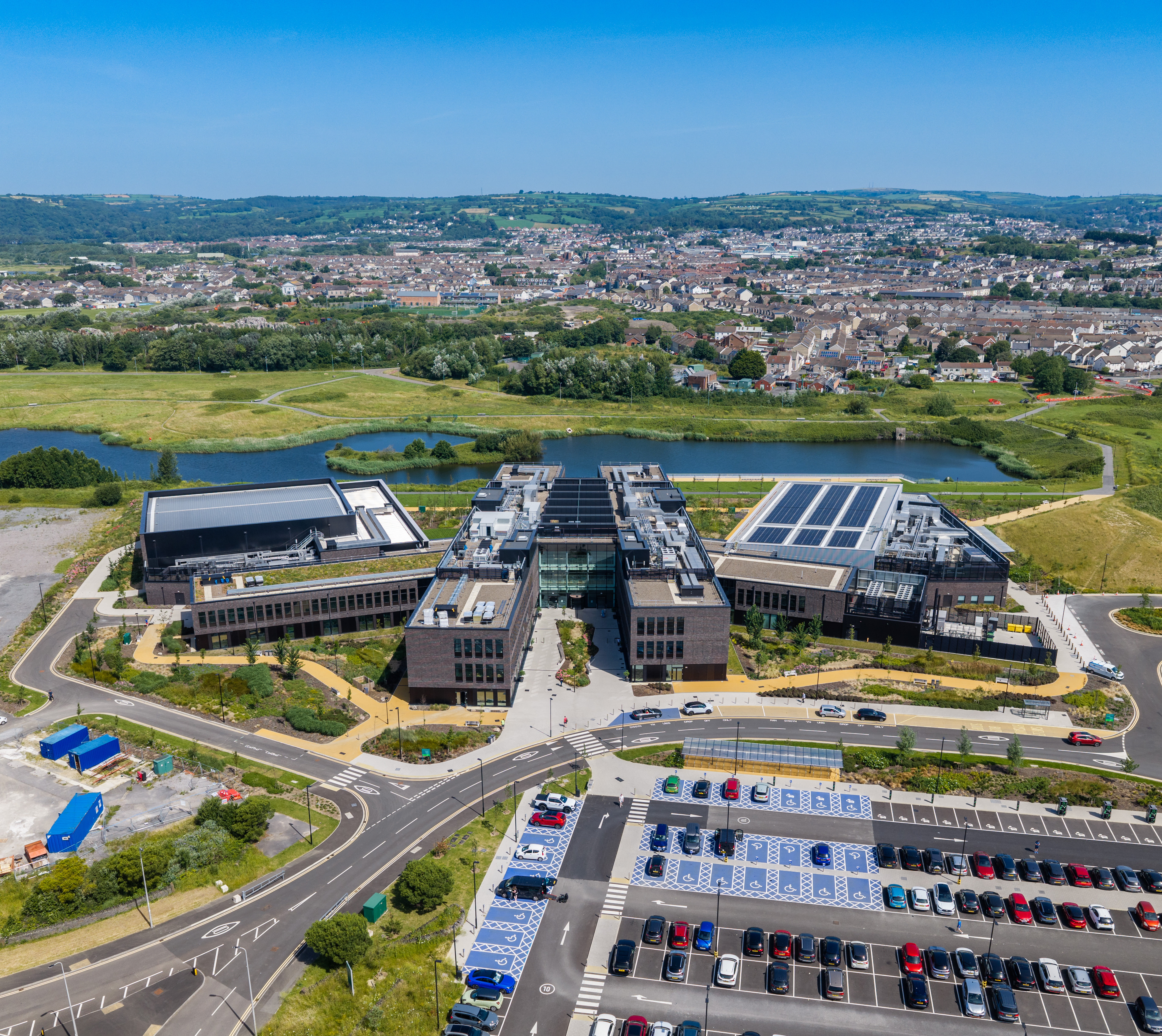 Pentre Awel, an 83-acre, public sector-led development in South Llanelli
What are you working on at the moment?
Steve: We’ve just finished a £90m development wellbeing centre, Canolfan, part of the Pentre Awel scheme, that’s achieved SBD Gold in a very challenging area which has a lot of crime. We’re 10 months in and we haven’t seen any crime or anti-social behaviour. It’s also very well used in the area and has transformed the community.
Gareth: I’m just working on a supported living complex in Cardigan, but it’s been paused because of Roman findings, the archaeological dig is almost over and we’re ready to proceed again.
How does it make you feel knowing that you have had such a significant impact on people’s lives?
Steve: I’m passionate about crime prevention, I firmly believe as a police force everyone should focus on the 10 principles of crime prevention, rather than just operating from one principle, ‘lock up the bad guy’. Reducing crime and preventing victimhood is key and this message should be across the whole force, not just in our role.
Gareth: Going back to our work with domestic abuse victims, it means the absolute world to make a difference to women and girls, and communities across Wales.
Any last words?
Steve: I’d like to give a shout out to Mid and West Wales fire and rescue service who regularly attend in joint visits with us to safeguard everyone from potential arson attacks.
Gareth: And to the Independent Domestic Violence Advisers and domestic abuse officers who strive to make victims safer.
Well done again to you both, we will leave you with some powerful words from their nomination, demonstrating that the work of a DOCO can have a wide-reaching impact
In the wake of the Angiolini report their practice reflects the very best of policing - proactive, survivor‑led, and uncompromising in its commitment to protection. Their work is not just crime prevention; it is restoration, empowerment, and the quiet, transformative support that changes lives.
Protecting victims/survivors of domestic abuse
Established in 1998, the SBD Sanctuary Scheme helps survivors of domestic abuse remain safely in their own homes, close to their support networks and local community roots.
Developed collaboratively by police crime prevention specialists, security installers, and the Fire and Rescue Service, the scheme installs practical, layered home security and dedicated safe rooms to keep families safe while emergency help arrives. Formally backed by the National Police Chiefs’ Council and National Fire Chiefs’ Council, it serves as a recognised accommodation-based support model under the Domestic Abuse Act 2021.
Learn more at https://www.securedbydesign.com/initiatives/sanctuary-scheme